
Villa Wadia - The plan award 2017
17/05/2017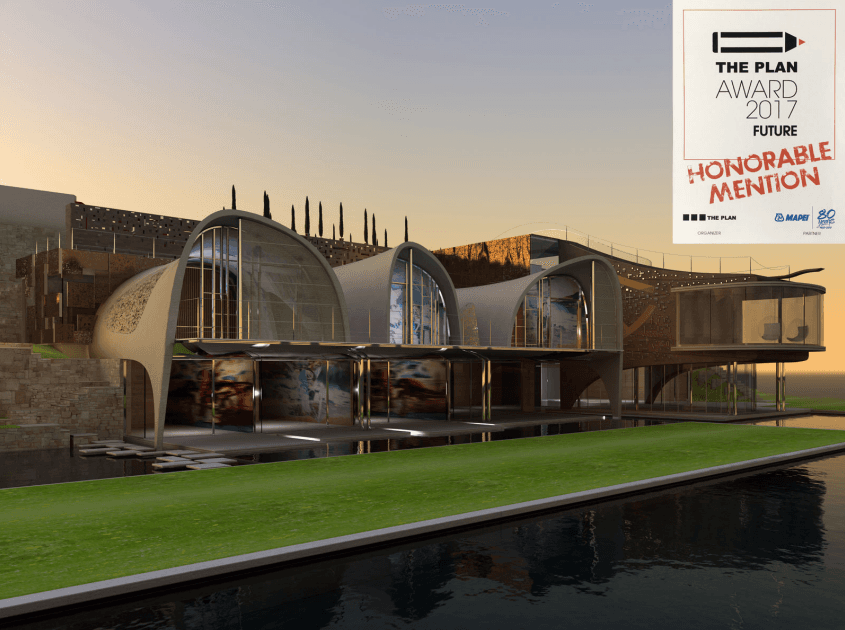
Villa Wadia is located in the Bautugan area (Cap d’Ail), a region of undeniable beauty and high landscape value, characterized by steep slopes and viewpoints of remarkable quality overlooking the sea. The very idea of the project is shaped by the morphology of the site, rooting its construction concept in the genius loci. By taking advantage of the site's characteristics, the villa integrates into the existing topography, enhancing its perceptual qualities and framing the landscape. The house is thus conceived as a sculptural element that fits into the terrain, creating an open space oriented toward the exterior.
The project involves the replacement of the existing building, with the requirement to maintain the original footprint and volumes.
The interiors are closely connected to the outdoor spaces. For this reason, the volume is fragmented, allowing the exterior to penetrate the interior and vice versa. Natural light interacts with the building, producing volumetric shifts and creating spaces with poetic resonance (citing Le Corbusier). In this way, the user is immersed in the environment, which surrounds them and stimulates the perception of the landscape.
The house is organized across three above-ground levels.
The roof level provides access to the interior of the building and offers the main view of the coastline. Different green outdoor spaces succeed one another in a promenade above the built volume. The projecting main volume references the morphology of Casa Malaparte by master architect Libera, with a stepped platform offering a privileged view of the landscape that metaphorically connects the house to the sea.
The first floor is composed of five volumes with distinct formal characteristics, structuring the interior space. Three large, asymmetrical, irregular white reinforced concrete sails form the sleeping area, opening the bedrooms toward the slope descending to the sea. The glazed main volume houses the living area, creating a space dedicated to daily leisure. The bronze volume, enclosing the master bedroom separated from the others, is interpreted artistically, with the material disintegrating outward and allowing soft, filtered light to enter.
The ground floor, more intimate, houses the guest rooms and the significant living area dedicated to the pool, establishing a physical connection with the endless pool, which dominates the outdoor space with a swimming lane running parallel to the villa.
These volumes are interconnected both spatially and functionally by two fundamental elements of the house. The retaining wall anchors the volumes to the mountain, distributes the spaces, and brings air and light to the basement where the owner, a former pilot, keeps a racing car museum. The large patio penetrates the levels, weaving visual connections between the different floors and creating outdoor spaces even at the basement level.
The project plays with the element of surprise, concealing views toward the uphill side, where the pedestrian entrance leads to a green terrace that hides the parking below. The path unfolds over this terrace, allowing the visitor to reach the panoramic terrace or enter the house. Access to the main floor is provided either via an elevator, suspended in the air and clad in perforated metal that appears to crumble, or via a staircase anchored to the retaining wall. Here, the true internal vertical connection is revealed as a glazed volume enclosing the connecting staircase.
This staircase descends to the first floor, consisting of a sleeping area with three bedrooms, a suspended living area overlooking the sea, and a master bedroom.
Descending further to the lower level, one reaches the large living area, the heart of the project, glazed onto the internal patio and closely connected to the garden and pool through fully openable glazing.
